

Deporting EU Nationals: What the Molnar Case Changes
Written by: Christopher Desira

A recent Court of Appeal judgment, Molnar v Secretary of State for the Home Department [2026] EWCA Civ 31 has significantly changed how EU nationals living in the UK can challenge deportation decisions.
As part of our work supporting civil society partners and organisations, Seraphus wants to make this complex area of law and its impact understandable to the sector and those working with EU citizens. In this article we will explain the judgement by the court, why it matters for advisers to EU citizens, and what legal protections remain.
When Can Someone Be Deported?
UK law creates a duty to deport a foreign national who receives a prison sentence (including a suspended sentence) of 12 months or more.
The Home Office also has a discretionary power to deport in other circumstances, including where:
- a person receives a suspended sentence of six months or more, or
- the Home Office considers the offence to have caused “serious harm.”
The “serious harm” category is particularly significant because it is not defined in legislation. Instead, the Home Office determines on a case-by-case basis whether an offence meets that threshold. This means deportation action can be pursued even where the sentence itself is relatively short or suspended.
What Extra Protection Did EU Nationals Have before the Molar decision?
EU nationals living in the UK under the EU Settlement Scheme benefit from rights preserved by the EU–UK Withdrawal Agreement.
The Molnar judgment determined that an EU proportionality assessment is not available where deportation is considered for offences committed after 31 December 2020.
A proportionality assessment asks whether deportation is a fair and reasonable response in the individual circumstances. The focus is not on whether the offence occurred, but on whether removal from the UK is justified.
Relevant factors typically include:
- length of residence in the UK
- level of integration
- family ties and caring responsibilities
- age and health
- seriousness of the offence
- risk of reoffending
For long-term residents, this could be a strong safeguard because the more established someone’s life in the UK, the harder it is to justify deportation.
What Did the Molnar Case Decide?
In Molnar v Secretary of State for the Home Department, two EU nationals with Withdrawal Agreement rights received deportation decisions for offences committed after 31 December 2020, the end of the Brexit transition period. Both had received prison sentences of more than 12 months.
They argued they were still entitled to a Withdrawal Agreement proportionality assessment, even though the offending occurred after the transition period.
The Court of Appeal rejected that argument.
The court held that for conduct occurring after 31 December 2020, the Withdrawal Agreement allows the UK to apply domestic deportation law without applying the EU proportionality test.
In practice, this means the Home Office only needs to demonstrate that the domestic legal threshold for deportation is met.
Some procedural safeguards remain; individuals must still receive written notice of the decision and have a right of appeal. However, it is clear from this judgement that the EU proportionality framework no longer applies to post-2020 offending.
What Remains Unresolved?
Despite the clarity of the ruling on proportionality, several issues remain open.
The court did not consider relevant interpretative guidance issued by the European Commission on the Withdrawal Agreement. That guidance suggests that procedural safeguards should continue to apply when rights are restricted, even where national law is used.
Because this argument was not raised in the case, it remains a potential line of argument in future litigation.
The court also hinted at a broader question but did not decide it: whether any part of the EU law framework applies to post-2020 conduct at all, including procedural protections preserved by the Upper Tribunal.
As the Home Office did not challenge that aspect of the earlier decision, the Court of Appeal could not rule on it. The issue may return to the courts.
Human rights protection
The right to respect private and family life under Article 8 of the European Convention on Human Rights remains available in deportation appeal.
Article 8 involves a general balancing exercise between the public interest in deportation and the individual’s personal circumstances. It can still provide meaningful protection, and meritorious arguments should still be submitted, but it is less structured than the EU proportionality test that previously applied.
Why This Matters, the case of Maria
The practical effect of the Molnar ruling can be seen in the case of Maria, a Dutch national aged 68 who has lived in the UK for nearly 50 years.
Maria arrived in the UK in 1976 and was granted settled status under the EU Settlement Scheme in 2022. She has not lived in the Netherlands since the 1970s.
In October 2024 she received a four-month suspended sentence for allowing premises to be used as a brothel. No victim was identified and she did not serve time in custody.
Her sentence falls below the normal statutory thresholds for deportation. Nevertheless, the Home Office has pursued deportation on the basis that the offence caused “serious harm.”
Her lawyer, Naga Kandiah of MTC Solicitors, argues that deportation would be disproportionate given her circumstances. Maria has lived in the UK for nearly five decades and has no meaningful support network in the Netherlands.
Because the offence occurred in 2024, the Molnar ruling means the Home Office does not need to carry out a proportionality assessment. It only needs to meet the domestic “serious harm” threshold.
Maria’s only remaining route of challenge is through Article 8 ECHR.
Her case illustrates the gap created by the Molnar judgment. Previously, decision-makers would have had to weigh her 50 years of residence, personal circumstances and lack of ties to the Netherlands as part of a proportionality assessment. That structured safeguard is not available for post-2020 offences.
What This Means for Advisers
For practitioners advising EU nationals with Withdrawal Agreement rights:
- Offences before 31 December 2020
The EU proportionality framework still applies. - Offences after 31 December 2020
Domestic UK deportation law applies and the EU proportionality test is not required. - Article 8 ECHR
This remains the main legal protection in deportation appeals. - Withdrawal Agreement arguments
Points based on European Commission guidance have not yet been tested in the Court of Appeal and may still be worth preserving. - Future appeals
As Molnar may ultimately reach the Supreme Court, proportionality arguments should continue to be raised where appropriate.
If you are an advisor in need of support with an EU settlement scheme case, please see the advice sessions we offer as a part of our work with the European delegation to the UK.
Seraphus, in its role as special adviser to the EU delegation to the UK, is keen to hear about cases where the ruling in the Molnar case may be applied. If you are advising a client affected by this decision, please get in touch with us via the contact us form to discuss their options.

-

Ethnic Minority EU Citizens and the EUSS
Written by: Caroline Echwald
A new report, Ethnic Minority EU Citizens in the UK (February 2026), highlights the barriers racialised EU citizens are experiencing in post-Brexit Britain. With funding from the EU Delegation the report is a result of a collaboration between academics and organisations working with migrants from racialised communities across the UK navigating post-Brexit systems. Here, we run through […]Read article -

The digital-only immigration system: exclusion in practice
Written by: Caroline Echwald
This article covers how a digital-only immigration system increases risk for marginalised communities. Since the Home Office introduced the digital immigration status and rolled out the eVisa, we have supported people navigating the new digital-only immigration system. This shift did not begin with eVisas. The EU Settlement Scheme (EUSS) was the first large-scale fully digital […]Read article -
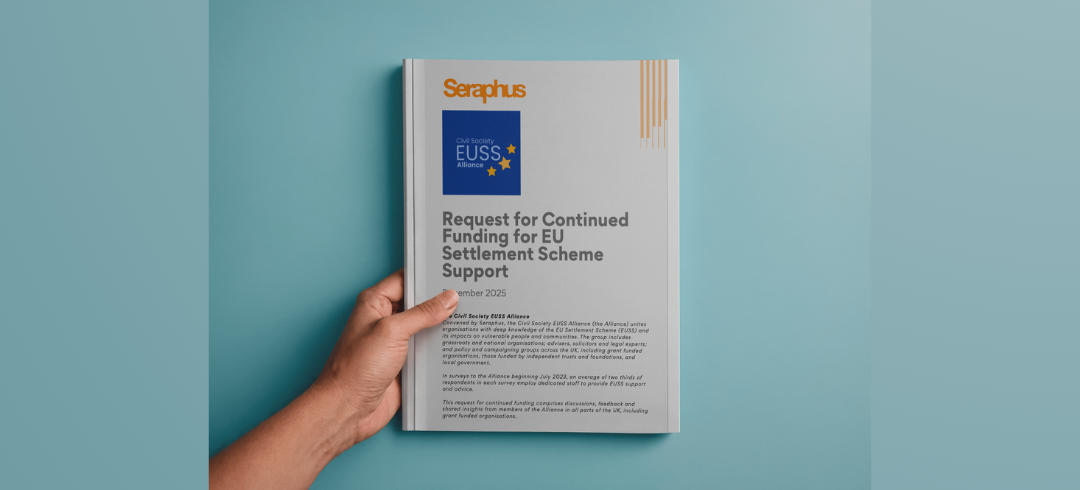
Securing the rights of EU citizens: The case for continued funding of the sector
Written by: Lydia Martin
Since the launch of the EU Settlement Scheme (EUSS) in 2019, civil society organisations across the UK have played a vital role in ensuring that vulnerable EU citizens and their family members are able to secure their rights under the Withdrawal Agreement. Through Home Office grant funding, these organisations have provided essential legal advice and […]Read article
Categories: EU Citizen Rights